Bookkeeping explained
Understand bookkeeping without jargon
A simple explanation of income, expenses, VAT, assets, corrections, and reports, with links to the current UurKlus documentation.
Basics
Bookkeeping in plain language
The core is simple: your administration should show what happened, what still needs to happen, and what that means for your business.
Bookkeeping keeps things clear
You record what you sell, what you spend, and which payments are still open. This shows where money comes from and where it goes.
Revenue, profit, and bank are different
Revenue and expenses follow the postings and the period to which they relate. Profit therefore differs from cash received or your bank balance. The balance in the app follows recorded transactions and is not a live bank balance.
Every entry has a place
For every entry, decide whether it belongs to revenue, costs, VAT, an asset, a liability, or private use. That choice determines your reports.
In UurKlus
How the parts fit together
The documentation explains per feature which choice to make and why that choice matters for bookkeeping.
Invoices
Create drafts, send final invoices, and correct cleanly with credit invoices.
Quotes
Create proposals and turn accepted work into a project or invoice later.
Expenses
Record receipts and supplier invoices with the right VAT type and ledger account.
Assets
Business assets used for several years generally require depreciation, considering acquisition and residual value. UurKlus supports ordinary movable assets; special schemes require separate assessment.
Projects
Bundle work, time, costs, and agreements per client or job.
Time entries
Track worked time per project and use it on your invoice.
VAT
VAT explained simply
VAT runs through many parts of bookkeeping: invoices, expenses, reports, and corrections.
VAT on sales
VAT on sales invoices is usually not revenue. You collect it on behalf of the Dutch Tax Administration.
VAT on expenses
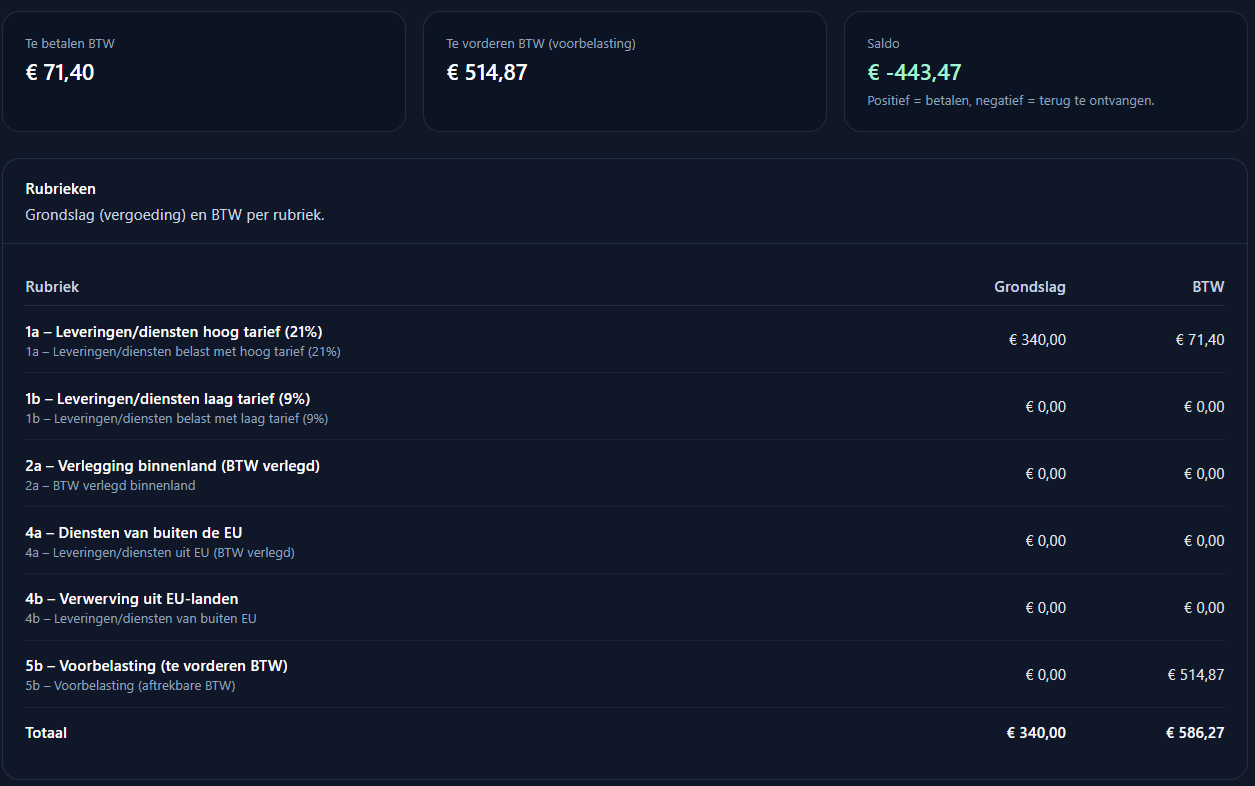
Only permitted input VAT belongs in 5b. KOR, exempt turnover, private use and certain expenses restrict deduction. Non-deductible VAT increases costs or acquisition value; foreign local VAT is not Dutch input VAT.
Correcting VAT
If a return has already been filed, fix mistakes visibly with a VAT correction.
The most important correction rule
For errors in a filed return, assess related differences together. Include a VAT difference up to EUR 1,000 in the next return. Above that, file a supplementary return as soon as possible and within 8 weeks of discovery.
Read the VAT correction guideReports
What your reports tell you
Reports turn separate entries into an understandable picture of your business.
Profit and loss
Shows the recorded result. Income or corporate tax may require tax adjustments; this report is not a tax return.
Balance sheet
Shows what you own, what you owe, and how much equity there is.
VAT overview
Shows VAT according to your postings, with filing amounts and checks. Review the period and completeness yourself, file externally, then record the matching report.
Open items
Shows which clients still need to pay and which suppliers are still owed money.
Terms
Short glossary
These words often appear in UurKlus, with your bookkeeper, and with the Dutch Tax Administration.
- Revenue
- The value of what you sell or invoice, usually excluding VAT.
- Costs
- Business expenses that reduce your result.
- Profit
- What remains after costs are deducted from revenue.
- VAT
- Tax charged on sales and often reclaimable on business purchases.
- Input VAT
- VAT that deduction rules allow you to offset, supported by a valid invoice and entitlement to deduct. Ordinary Dutch purchases do not have to be paid first.
- Debtor
- A client who still needs to pay you.
- Creditor
- A supplier you still need to pay.
- Balance sheet
- An overview of assets, liabilities, and equity at a specific moment.
- Depreciation
- Spreading a larger purchase over multiple years.
- VAT suppletion
- A separate correction for an earlier VAT return, usually needed for corrections above EUR 1,000.
Want to know exactly how to do something?
Use this page for the basics and the documentation for exact steps per feature.